Table of Contents
ToggleKeeping houseplants alive during winter months or in rooms with limited natural light can feel like a losing battle. Leggy stems, pale leaves, and stunted growth are telltale signs that your green friends aren’t getting enough light. That’s where grow lights come in, an accessible, practical solution for anyone who wants lush, healthy plants regardless of window placement or seasonal light shifts. Whether you’re cultivating herbs on a kitchen counter, nursing tropical plants in a basement, or simply supplementing weak winter sun, understanding how grow lights work and which type suits your needs can transform your indoor gardening game. This guide walks through everything from light spectrum science to installation logistics, so you can make informed decisions and watch your plants flourish.
Key Takeaways
- Grow lights for indoor plants solve insufficient natural light by delivering consistent, controllable light at proper intensity and spectrum, with most houseplants needing 12–16 hours of light daily.
- LED grow lights dominate the market due to superior energy efficiency, longer lifespan (50,000+ hours), and cost-effectiveness compared to fluorescents, though initial investment is higher.
- Match light intensity to plant type: seedlings need 100–200 µmol/m²/s, medium-light plants (herbs and most houseplants) need 200–400 µmol/m²/s, and high-light plants need 400–600+ µmol/m²/s.
- Proper placement, height adjustment, and consistent timer-based photoperiods are essential for success—position lights directly above plants at 6–18 inches depending on fixture type, and maintain 14–16 hours daily.
- Supplementing natural daylight with grow lights reduces energy costs and often produces healthier results than relying on artificial light alone.
Why Your Indoor Plants Need Grow Lights
Sunlight drives photosynthesis, the process plants use to convert light into energy. When natural light is insufficient, growth slows, leaves drop, and flowering plants refuse to bloom. North-facing windows, basements, and winter’s short days simply don’t deliver the intensity or duration most houseplants require.
Natural light diminishes rapidly indoors. Even a spot that feels bright to human eyes often measures just 100–500 foot-candles, while many tropical and fruiting plants need 1,000+ foot-candles to thrive. Grow lights compensate by delivering consistent, controllable light on a predictable schedule.
Another factor is light spectrum. Sunlight contains the full spectrum of wavelengths, but indoor artificial light, especially standard incandescent or cool-white bulbs, skews heavily toward limited bands. Plants rely on blue wavelengths (400–500 nm) for vegetative growth and red wavelengths (600–700 nm) for flowering and fruiting. Quality grow lights balance these spectrums to mimic natural conditions.
Grow lights also extend the photoperiod. Most houseplants need 12–16 hours of light daily for robust growth. In winter, natural daylight may last only 8–10 hours, leaving plants starved for energy. A timer-controlled grow light setup ensures plants receive adequate exposure year-round, preventing the seasonal slump that plagues so many indoor gardens.
Types of Grow Lights: Finding the Right Fit for Your Space
Choosing among the best grow lights for indoor plants starts with understanding the core technologies. Each type offers distinct advantages in efficiency, cost, and application.
LED Grow Lights
LED grow lights dominate the market for good reason. They’re energy-efficient, run cool, and last 50,000+ hours, roughly ten times longer than fluorescents. Modern LED grow lights for indoor plants deliver targeted red and blue spectrums, or full-spectrum white light that mimics daylight.
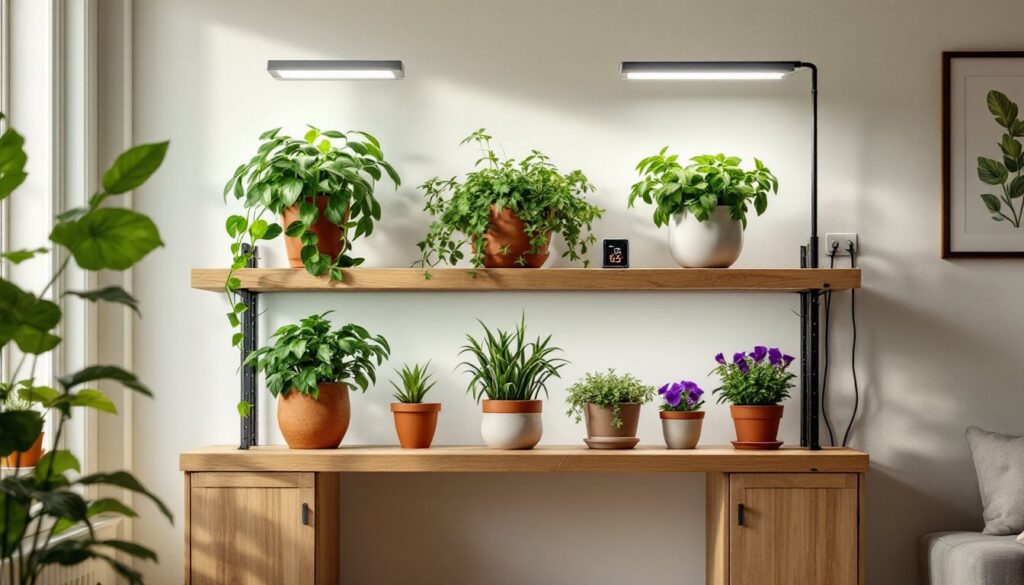
LEDs come in several form factors. Panel-style units mount above plants and work well for shelving or dedicated grow stations. Bulb-style LEDs screw into standard E26 sockets, making them perfect for desk lamps or clamp fixtures. Strip lights offer flexible mounting for tight spaces like under cabinets or along shelves.
Wattage matters, but don’t confuse it with brightness. A 30-watt LED grow lamp for indoor plants can outperform a 100-watt incandescent because LEDs convert more energy into usable light rather than heat. Look for units rated in PPFD (photosynthetic photon flux density), measured in micromoles per square meter per second. Most leafy greens and herbs thrive at 200–400 µmol/m²/s, while flowering plants need 400–600+.
Heat output is minimal with quality LEDs, so you can position them closer to foliage, typically 6–12 inches, without scorching leaves. This proximity boosts light intensity and efficiency. Some advanced models include dimming controls and programmable timers, adding flexibility for different plant types or growth stages.
Fluorescent and CFL Bulbs
Fluorescent tubes (T5, T8, or T12) have been the workhorse of indoor gardening for decades. They’re affordable, widely available, and effective for seedlings, herbs, and low-to-moderate light plants. T5 fixtures are the current standard, offering better efficiency and output than older T8 or T12 models.
Fluorescent growing lamps for indoor plants work best within 3–6 inches of the canopy, as intensity drops sharply with distance. They’re ideal for shelf setups where you can adjust fixture height as plants grow. Expect to replace tubes every 12–18 months as phosphor coatings degrade and light output diminishes, even if the bulb still glows.
Compact fluorescent lamps (CFLs) screw into standard sockets and suit small-scale applications, think a single potted orchid or a countertop herb garden. They’re less efficient than LEDs and produce more heat, but they’re inexpensive upfront and easy to integrate into existing fixtures.
Both fluorescent and CFL options come in color temperatures measured in Kelvin. Cool white (5000–6500K) emphasizes blue spectrum for leafy growth, while warm white (2700–3000K) leans red for flowering. Full-spectrum bulbs (often labeled “daylight” or “grow”) blend both, though dedicated grow-specific tubes often outperform general-purpose fluorescents in plant trials.
How to Choose the Best Grow Light for Your Indoor Garden
Selecting the best grow light for indoor plants depends on plant type, space constraints, and budget. Here’s how to narrow the field.
Match light intensity to plant needs. Seedlings and low-light plants (pothos, snake plants, ferns) do fine with 100–200 µmol/m²/s or basic fluorescent setups. Medium-light plants (most houseplants, herbs) need 200–400 µmol/m²/s, achievable with mid-range LEDs or T5 fixtures. High-light plants (succulents, citrus, tomatoes) demand 400–600+ µmol/m²/s, typically requiring higher-wattage LED panels or multiple fixtures.
Consider coverage area. Manufacturers list effective footprint, often something like “2×2 feet at 18 inches height” for flowering or “3×3 feet” for vegetative growth. Measure your growing area and choose a unit that covers it with some overlap. Underpowered coverage leaves edge plants stretching toward light, while oversized fixtures waste energy.
Factor in mounting and adjustability. If you’re retrofitting existing furniture, LED lights for indoor plants that clip onto shelves or screw into desk lamps offer flexibility. Dedicated grow stations benefit from hanging panels with adjustable chains or pulleys, allowing you to raise the light as plants mature. Some growers prefer modular grow light systems that scale with expanding collections.
Check for spectrum customization. Full-spectrum white LEDs simplify things and look natural to the eye, important if lights run in living spaces. Dedicated red/blue “blurple” LEDs maximize photosynthetic efficiency but cast an unnatural purple glow. Hybrid units with switchable modes or dimmable channels let you tailor output to growth stage.
Evaluate energy costs and lifespan. LEDs cost more upfront but pay back through lower electricity bills and longer service life. A 30-watt LED running 14 hours daily uses roughly 13 kWh per month: at $0.13/kWh, that’s about $1.70 monthly. Comparable fluorescent setups consume 50–100% more power for equivalent output. Calculate operating cost over three years to compare true value.
Don’t ignore thermal management. Even efficient LEDs produce some heat. Passively cooled units with aluminum heat sinks work for most home setups, but high-output panels may need active cooling fans, which add noise and potential points of failure. Ensure adequate ventilation if clustering multiple fixtures in enclosed spaces.
Setting Up Your Grow Light System: Practical Tips for Success
Installation is straightforward, but a few best practices prevent common mistakes and maximize results.
Start with proper placement. Position lights directly above plants, centered over the canopy. Side-angled light causes uneven growth and leggy stems. For panels, use adjustable hangers or S-hooks on chain to maintain optimal distance as plants grow. Clamp lights or screw-in bulbs should aim downward, not horizontally.
Set the right height. LED panels typically start 12–18 inches above seedlings, moving to 6–12 inches for mature plants, consult manufacturer specs. Fluorescent tubes sit closer, around 3–6 inches. Watch for signs of stress: bleached or curling leaves mean too close: stretching stems and pale color indicate too far. Adjust in 2-inch increments and monitor for a week.
Use a timer for consistency. Plants need regular light cycles. Most houseplants thrive on 14–16 hours of light, 8–10 hours of darkness. Seedlings can handle 16–18 hours. Programmable digital timers (available at any hardware store) eliminate guesswork and ensure plants don’t miss a cycle when you’re away. Avoid 24-hour light, plants need dark periods to complete metabolic processes.
Supplement, don’t replace, natural light when possible. If your space gets a few hours of direct sun or bright indirect light, grow lights can top off the deficit rather than shoulder the entire load. This hybrid approach cuts energy costs and often produces healthier growth than artificial light alone. Many experienced indoor gardeners rely on practical home and garden resources to fine-tune their lighting schedules.
Monitor electrical load and safety. Most grow lights draw modest power, but stacking multiple fixtures on a single outlet or power strip can trip breakers or create fire hazards. Check the combined amperage (watts ÷ volts) and stay below 80% of the circuit’s rated capacity. Use GFCI-protected outlets in damp environments like laundry rooms or basements. Keep cords away from water sources and inspect regularly for fraying.
Adjust for seasons and plant life cycles. Even with grow lights, some plants benefit from seasonal light variation. Reduce photoperiod slightly in fall to trigger dormancy in species that need it (like some succulents), then ramp back up in spring. For flowering plants, switching to a 12-hour cycle can induce blooming, while 16–18 hours supports vegetative growth.
Rotate plants periodically. Light intensity diminishes toward fixture edges, so rotate pots every week or two to ensure even exposure. This is especially important with single-bulb setups or asymmetric fixtures.
Keep fixtures clean. Dust and grime reduce light transmission by 10–20% over time. Wipe LED panels and tubes monthly with a dry microfiber cloth (power off first). For designs inspired by functional indoor gardens, many turn to sources like country-style home projects that blend aesthetics with practicality.
Safety note: Always wear eye protection when working near high-intensity grow lights, especially UV-supplemented models. Prolonged direct exposure can strain eyes. Mount fixtures securely to prevent falls, use appropriate anchors for drywall or toggle bolts for hollow walls if hanging heavy panels.
Conclusion
Grow lights turn dim corners and sunless seasons into productive growing spaces, giving indoor gardeners control over light quality, intensity, and duration. Whether you opt for energy-sipping LEDs or budget-friendly fluorescents, the key is matching your setup to plant needs and maintaining consistent schedules. With the right fixture, proper placement, and a bit of attention, you’ll see stronger stems, richer foliage, and the kind of vibrant growth that only comes when plants get exactly what they need, even when the sun doesn’t cooperate.